TO MAKE OR NOT TO MAKE A FILM IN CYPRUS?

INSIGHT by Elvan Levent
May 22, 2026
I remember how difficult it was to gather a crew and find actors when I decided to shoot the 14-minute film Tanık ('Witness') in northern Cyprus in 2014. The reason I didn’t even attempt to seek funding for this film was that it focused on the issue of “missing persons” in Cyprus and was therefore a politically charged film. The question of whether an independent institution, company, or individual in Cyprus would support a politically charged film is akin to guessing whether you’ll win the lottery. For this reason, I shot the film with a crew entirely from the south, amateur Turkish Cypriot actors, and my own financial resources. The film was awarded the Jury Special Prize at the International Snowdance Film Festival, yet it was never screened in the southern part of the island.
Today, when I look at what has changed regarding filmmaking in Cyprus after a 12-year gap, I must say I see a disheartening picture. While I couldn’t find a producer or production company in the north for the new film I plan to shoot, not a single one of the five production companies I contacted in the south even provided a meaningful response regarding costs.
I asked Cypriot directors about what it’s like to shoot a film in Cyprus and the reasons why the film industry on the island has remained stagnant.

Doğuş Özokutan -
Vasvİ Çİftçİoğlu
Vasvi Çiftçioğlu: When we were making our first film, Random Attempts, we looked everywhere for funding but couldn’t find any. I remember searching for funding everywhere.
In the end, we decided to make the film by taking out a loan from the bank. Since we had previously made documentaries, we had our own equipment, but we wanted to make this short fiction film using cameras and equipment of a quality that would allow us to see it on the big screen. That’s why we had to take out a loan; we made it by borrowing money. But there wasn’t a single person we didn’t knock on the door of. If I were to list them one by one, we went to every conceivable place in the private sector, but we couldn’t find any funding. Also, there was no crew or equipment in the north of Cyprus. I mean, there are plenty of people working in television.
But there was no crew or equipment capable of producing cinema. Consequently, our cinematographer came from the Netherlands. He brought a Red camera. Our budget was very limited. Since there wasn’t a single technically trained person on set - like a gaffer or sound technician - we ended up shooting the film without the sound, for example. All the sounds in that film were recorded later in the studio.
Elvan: How long did the shooting process take?
Vasvi: We shot the film in May 2014 over three days. But we didn’t finish editing the film until January 2015. So it took eight months after we finished shooting. It was entirely due to financial constraints. This part is also somewhat related to money. In other words, the editing could have been finished in a week, but we managed to finish it in eight months. Since the film’s sound would be added later, and because we couldn’t find anyone in Northern Cyprus capable of handling the sound design, we asked our cinematographer for a recommendation on where we could have the sound design done. He suggested a studio in Netherlands to us. We sent them an email and told them who had referred us, shared the rough cut of the film, and asked how much they could do the sound design for. A few hours later, they sent me a response. They quoted a price of around €3,000 for the sound design, plus VAT. The VAT was 10%, so the total cost came to €3,300...
Doğuş Özokutan: We were joking around among ourselves, and I told Vasvi, “We can only afford the VAT (laughs)… Vasvi turned around and wrote that to them.
Vasvi: Yes, on a whim, I wrote exactly that in the email… I said, “We’re independent filmmakers, our funds are exhausted, so we can only pay the VAT on this fee.” They replied within an hour or so, saying they really liked the film and could handle the sound design for just the VAT amount. They said, “For future projects, you can pay the full fee when you have the money…” They made this gesture because they thought the film had good potential, and that’s how we were able to finish it. Otherwise, we wouldn’t have been able to… Later, they were very happy with the film’s success and shared the awards it won on their website. So they were a bit of a volunteer, and they operate on a volunteer basis. The cinematographer is the same. So we couldn’t pay everyone on set exactly what they deserved, but we paid everyone whatever amount we had; we tried to pay everyone on time as we had promised.
Elvan: So, what was the total budget for the film?
Vasvi: It’s been a long time, I don’t remember the exact amount, but I’d say it came to around €10,000. For us, that was a huge amount back then…
Elvan: How long was the film?
Vasvi: 7 and a half minutes…
Elvan: Actually, €10,000 euros for a 7 and a half-minute film isn’t small even by today’s standards…
Vasvi: Let me put it this way: when we tell people at the international festivals we attend that we made a film for that amount, they’re very surprised… In the South, for example, that amount is at least five times higher. In Europe and America, it’s nine to ten times higher… So, a 10-minute short film for under €100,000 (shakes his head in despair)…
Doğuş: In my communications with people I reached during the budget-seeking phase, I saw that the difficulty regarding this issue stems from two distinct problems: a mindset issue - that is, the value an individual or society places on art - and secondly, a systemic issue… I don’t want to cast anyone in a negative light, but in a country where people on the list of the world’s wealthiest reside, it’s already clear how much tax is collected from whom… If we had a proper tax system and support for the arts were tax-deductible, we’d be having a different conversation. That’s why, after the first film, we didn’t go knocking on anyone’s door for sponsorship again.
You can only go so far in overcoming a systemic problem through individual effort. I mean, it might look good from the outside - like, we took out a bank loan when we had nothing, made a film, and it was very successful, winning awards at international festivals… But that’s not proof that cinema can be made this way.
Vasvi: It’s proof of how it shouldn’t be done (laughs)...
Doğuş: Maybe a person finds that energy once, or twice—if they’re lucky enough to find it…
Vasvi: Professional filmmaking isn’t like that…
_____________________
**Random Attempts traveled to 23 countries, attended 41 festivals, and won 3 international awards.
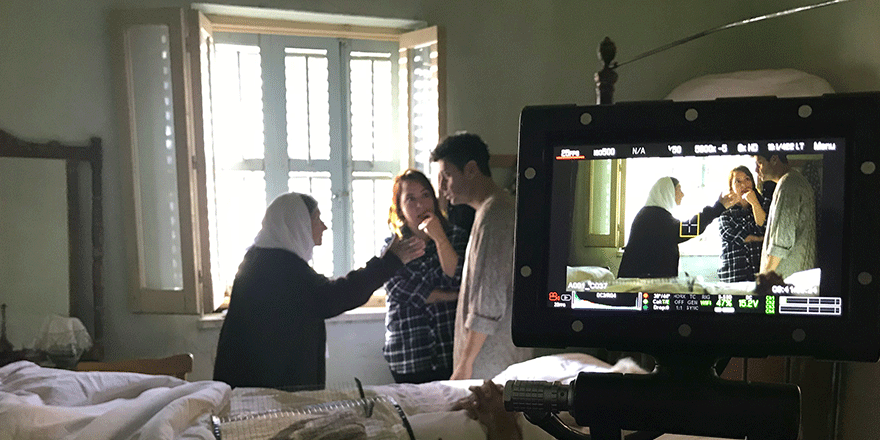
On the set of the short film Kısmet, directed by Doğuş Özokutan and Vasvi Çiftçioğlu
Talat Gökdemİr
Talat Gökdemir: There are many active people in the North Cyprus, but they’re mostly active in an intellectual sense. In other words, there are many people interested in film and wanting to advance in this field, and generally, you experience this kind of excitement and search during the early part of your life - in your 20s and 30s. But because they aren’t supported much, and since there isn’t much financial return, when they want to move forward in life or start a family, many people turn to a sector that can provide them with financial security and take a full-time job. They keep filmmaking as a hobby they do on the side every now and then.

As a result, that love for cinema gets pushed further and further into the background over time and eventually fades away. If I were in Cyprus right now, the same situation would likely apply to me… That’s why I went to England; after finding a job that provides me with financial security, I use the money I’ve saved to make short films. Otherwise, these projects are very difficult in Cyprus. Because there are no funds you can apply to or receive support from… Even if there were, the films people might want to make could be seen as opposition, so this time the obstacle of censorship would arise…
For example, I had a very hard time making the film Konsomatris. I had to tell a lot of lies because there was no support from anywhere. For instance, we needed to shoot at a school for the film, but if I went to the school and mentioned the subject, I definitely wouldn’t have gotten any support. I went to the Ministry of Culture, I went to the Ministry of Education, and I said we had this story, but I didn’t reveal the full story - I just mentioned that there was a scene set in a school and that we wanted to film it there. That’s how I got permission, and we filmed that scene at the school.
But of course, a year or so later, when news about the film started appearing in the papers, the lies I’d told came to light. And one day while I was in the office, someone called from a Cypriot number - it was either someone from the Ministry of Education or the Ministry of Culture. They started yelling at me over the phone. And they told me that the fact that the film’s title was ‘Konsomatris’ was reason enough for them not to support such a film. So forget the film’s plot - the title alone was an obstacle to filming it.
I understood the necessity of telling a lie better at that point (laughing)... So even if you find financial support, these kinds of obstacles exist, which is why I think making films in Cyprus - and people being able to shoot films - is quite difficult. However, perhaps romantic comedies can be made without delving into such political and social issues. That’s the current situation in the North.
In the South, there are more people professionally involved in cinema. In other words, there are people who make a living entirely from this work. For example, this year a full-length film from Cyprus was selected for the Sundance Film Festival for the first time, which is a pretty significant event… So, yes, the South and the North are very different in terms of filmmaking…
Elvan: Did you try to seek for funding in the North?
Talat: Yes, we did. For instance, when we were planning to shoot the film Weekend, we met with the Northern Cyprus representative in London. The advice he gave us was to reach out to wealthy businessmen with more money. There weren’t any other funds available anyway. That’s why I shot the film using my own savings, and the crew either worked for free or for very little pay. We had no other choice. In fact, the main reason I shot my latest film, Night Shift, in the south was precisely this. Because there’s a fund you can apply to there.
Elvan: So, after applying to the Cyprus Film Commission for funding in the south, how did that process proceed?
Talat: It was a very long process. I wrote to many production companies to find a producer. I sent them the plot of the screenplay and information about the films I’d made previously. I told them they could contact me if they were interested. Out of all of them, only one company got back to me. They said they liked the film’s premise and told me to leave everything related to the production process to them. I also had some names I wanted to work with. In that regard, our communication wasn’t great, but there was a cinematographer both they and I wanted to work with: George Rahmatoulin. I spoke with George, and he recommended a young producer to me and suggested I apply to the film committee entirely as a freelancer. We applied that way. I think I was also lucky because Ioanna (the producer) was very young, and although she had worked on other projects in the industry before, this film was her first experience as a producer, and so - since she also loved the film’s plot - she worked on it with great enthusiasm.

Talat Gökdemir with the actors during the shooting of the Night Shift.
Elvan: What was the process like during the film’s production phase?
Talat: The biggest challenge was finding a producer. I suppose I was lucky because, even though it didn’t work out with the first producer I spoke to, we reached an agreement with the second one; otherwise, it was possible that I could have spoken with five or six producers and still not found common ground with any of them. Once we found the producer, things got easier because people she’d worked with before joined the project, and so we made agreements with them - not formal contracts, but more like signed letters. We have to do this during the application phase. Because without these, it’s quite difficult to stand out among other applications. Especially as a Turkish Cypriot, you kind of think your chances are slimmer among all the Greek Cypriots (laughing)... Because there’s always this thought in your head: If such a fund is opened every year or every two years, maybe one will go to a Turkish Cypriot… So you have to constantly push to stand out. Then a long application period begins. We provide quite detailed information, including a 50–60-page detailed breakdown of the film’s production process.
Elvan: The film’s shooting took a total of four days, right?
Talat: Yes..
Elvan: So how long was the process from the idea’s conception to the completion of filming?
Talat: Five years… (laughing)… We started in January 2021. To be completely honest, the €21,000 financial support budget we received was, of course, quite insufficient. So if I didn’t have a full-time job and hadn’t saved up my own money and set it aside, making this film would have been impossible.
Elvan: Well, your film’s main budget was €56,000 Considering that technical capabilities for filmmaking are much more advanced today compared to the past, shouldn’t film production have become less expensive? In other words, why does a 17-minute short film that can be shot in four days require a budget of €56,000
Talat: Let me put it this way: at the international platform we joined to develop the screenplay, the budgets for some other projects had already been set, and their drafts were ready. Our film’s budget was the lowest among them… We’re talking about budgets in the hundreds of thousands. Personally, of course, that’s a lot for me. But when compared to Europe, it’s actually nothing… And in fact, even a €56,000 budget isn’t enough for our film, which takes four days to shoot, because so many people are involved, and the production process isn’t limited to just four days - there’s the time before and after, rehearsals, preparation phases, camera tests… It’s actually very hard to explain this to someone… So, for example, when I talk to my family about this, they say, “Why are you bothering with this? You’re not making any money from it,” (laughing)…
Talat Gökdemir:
"When we were planning to shoot the film ‘Weekend,’ we met with the Northern Cyprus representative in London. The advice he gave us was to reach out to wealthy businessmen with more money."
National Funding

While there is no government support or funding scheme in the North part of Cyprus (TRNC), the Republic of Cyprus provides direct funding to 6-10 films annually. The Cyprus Cinema Advisory Committee (CCAC) is the principal mechanism for the allocation of public funding of film production in Cyprus through recommendations to the Director of the Department of Contemporary Culture. It consists of nine members appointed by the Council of Ministers.
**The Committee has kindly responded to several of the questions we have directed to them:
How does the funding scheme works?
The funding scheme for the support of cinematographic works covers all stages of film production for features, shorts, documentaries, and animation, from screenwriting to distribution/exhibition and festival participation. It also includes the category of minority co-productions, facilitating the participation of Cypriot talent and technical crew in international co-productions promoting capacity building and international cooperation.
How is the funding decisions are guided?
Funding decisions are guided by a set of qualitative and policy-based criteria, including:
-
Artistic and technical quality of the project;
-
Cultural and social relevance, particularly in relation to Cypriot identity and narratives;
-
Production feasibility and budgetary soundness;
-
International potential and contribution to the visibility of Cypriot cinema;
-
Commitment to gender balance and inclusivity in creative teams.
The Committee’s mandate is to ensure a balanced allocation of resources that reflects national cultural policy objectives, promotes artistic innovation, and supports a diverse range of audiovisual works.
Local filmmakers often highlight limited budgets as a challenge. Are there plans to expand the committee’s funding capacity or introduce new funding models to support more ambitious Cypriot projects?
We are currently exploring options to introduce a new funding programme for high-end limited TV Series, covering the stages of screenwriting and/or development.
What is being done to strengthen the domestic Cypriot film industry and support local filmmakers?
The Deputy Ministry of Culture places significant emphasis on enhancing the resilience and sustainability of the domestic film ecosystem. Key priorities include:
-
Systematic revision of national funding schemes for feature films, documentaries, short films, script development and independent productions, upon consultation with the Directors Guild as well as with partnering producers. Any revision process takes into consideration the regulatory framework provided by the European Commission and the latest Council of Europe Convention on the support of cinematographic works as well as best practices across Europe upon relevant exchanges with our counterparts and partner organisations.
-
Support for Cypriot films at international markets and festivals, with the objective of increasing visibility and export potential.
-
The promotion of film education and exhibition through the support of film festivals, film clubs and film events, aiming at audience development as strategic priority. We are currently exploring new opportunities for expanding the local interest in cinema-going, including the introduction of film education in formal education through collaborations with the Pedagogical Institute (Ministry of Education), EKKOMED and the European Film Academy.
-
Support of film distribution and exhibition in Cyprus and abroad, including the support of decentralised distribution and exhibition activity (e.g. dedicated funding schemes for countryside cinema theatres and independent single-screen theatres).
Cyprus Film Days and similar festivals are adding more training and networking activities. How is the state supporting these initiatives to connect Cypriot cinema with Europe and the Middle East?
The state supports the growing training and networking activities taking place in the context of the two state co-organised film festivals, namely Cyprus Film Days and ISFFC, both financially and institutionally. “Dot on the Map” is the main industry event taking place in the context of Cyprus Film Days which includes workshops, masterclasses, panel discussions and – most importantly – a co-production pitching lab for filmmakers from the Mediterranean region, including Middle Eastern filmmakers, thus creating a regional hub for networking, collaboration and development.
“TGF” (Talents Generator Factory) is an intensive short film development writing workshop, organised in the context of ISFFC, for directors and screenwriters from Cyprus and the neighbouring Mediterranean countries. Both festivals also organise parallel activities, offering opportunities for networking and training in collaboration with production and post-production companies.
Moreover, the Department offers financial support to independent film festivals, such as the Lemesos Documentary Film Festival, Animafest Countryside Festival and Queer Wave Film Festival, which also offer opportunities for training and networking through their parallel activities and educational programmes.
In addition to the above, the Department is a member of several sectoral international and European organisations, including EFAD (European Film Agencies Directors), SEE (South-Eastern Europe) Cinema Network, EFP (European Film Promotion), as well as a founding member of Eurimages (Council of Europe Co-Production Fund). Through these memberships a range of opportunities for local filmmakers, institutions, festivals are offered at the level of training, co-producing, programming, distribution and exhibition.
These memberships create key platforms for collaboration between stakeholders at the level of policy making but also to connect Cypriot professionals with European and Middle Eastern counterparts through co-production markets, pitching forums, and talent labs. The Department facilitates international partnerships, travel grants, and festival collaborations, aiming to position Cyprus as a cultural bridge between the two regions and to help emerging filmmakers build sustainable international networks.
longınos panagı:
"Many young filmmakers seem to escape from our traditional political narratives, just by turning their back to the problem. But let’s not forget that the problem is still there. It is lying there disguised, in almost all our films."

Longinos Panagi
Elvan Levent: How would you describe the current state of the film industry in Cyprus, and what do you see as its greatest strengths and weaknesses today?
Longinos Panagi: The film industry in Cyprus is going through a transitional period. Over the last decades it has grown markedly, thanks to the emergence of young, talented filmmakers and to
the efforts of dedicated people at the Cyprus Cinema Advisory Committee. At the same time, there is a plethora of film festivals, such as: the established Cyprus Film Days and the International Short Film Festival of Cyprus, Lemesos International Documentary Festival, Images and Views of Alternative Cinema, Animafest Cyprus, Cyprus Archaeological, Ethnographic & Historical Film Festival and, more recently, the Queer Wave. Such a diverse offering was unimaginable back in the nineties, when I finished my studies in cinema. Additionally, the introduction of the cash rebate and tax incentives program promises to attract big foreign productions and connect them to the local community. On the other hand, I believe that there is a lot to be done in film education, a necessity for the growth of Cyprus cinema that is largely overlooked.
Elvan: What are the main structural or institutional challenges Cypriot filmmakers still face particularly in terms of funding, distribution, and international visibility?
Longinos: Still, the only way to fund a film is to apply to one of the programs offered by the Cinema Advisory Committee of the Deputy Ministry of Culture. These programs support most of the local productions, in one way or another. There are no serious private initiatives to offer any kind of financial help. Thankfully, more local films are now acting as co-productions between different countries, mostly supported by European funding bodies. This is also an asset in distributing the film outside of the country. It is always hard, living in a small island, to gain international visibility, but I think we have a lot to be proud of in the recent years. Such is the awarding of many Cypriot films in internationally acclaimed Festivals.
Elvan: Cyprus has a complex cultural and political landscape. How do you think this reality influences storytelling and cinematic themes emerging from the island?
Longinos: With the latest geopolitical developments and wars once again encircling our troubled neighborhood, things are getting even more complex and intense. Everybody in Cyprus is still suffering from the consequences of division and war. So, there is a great feeling of distress hidden under the seemingly calm surface, in both sides of the island. I have dedicated my PhD thesis on this topic, examining how this psychological suffering is transferred from generation to generation. Many young filmmakers seem to escape from our traditional political narratives, just by turning their back to the problem. But let’s not forget that the problem is still there. It is lying there disguised, in almost all our films. Now I would like to see a different kind of storytelling, stories that ease the political and ideological tension between different parts of society.
Elvan: What advice would you give to young filmmakers in Cyprus?
Longinos: I would advise them to think and dream bigger than their little island, without ignoring their roots. I remember, one of our teachers at the film school, used to say that the more local a film, the more global it is. There are many stories out there, like flowers waiting for us to be picked. One must first see them, then appreciate their beauty. And finally, make this beauty recognizable for the audience to see.

A still image from the film Clementine, directed by Longinos Panagi.

Buğra Özverel
Buğra Özverel: My experience with filmmaking in northern Cyprus occurred while I was seeking funding to move the film I was working on into the production phase. The biggest obstacle I faced at this stage - and one I anticipate might resurface in later phases of film production - was the lack of any established concept of filmmaking in the public consciousness. The dialogue I had with a few large companies I approached for sponsorship and budget support was limited to suggestions like, “I’ll provide five thousand lira in support,” (5,000 Turkish Liras = €94 -Avfri) or “I’ll provide a daily supply of 5 liters of water.”
This is not only highlighted a general lack of understanding regarding the scope and scale of a film production process but also revealed, through the attitude of the other party in these conversations, that they viewed it as a hobby and perceived the support they were offering as a form of charity.
The fact that artistic production - and film production in particular - occupies the lowest rung of the hierarchy of needs in the mindset of the Northern Cypriot society constitutes a serious obstacle for all stages of film production from my perspective.
Elvan: As someone with experience in the film industry in Turkey, what do you think are the main reasons why cinema has not developed into an industry in Cyprus?
Buğra: As I mentioned earlier, the public’s lack of familiarity with the concept of film production and the perception of cinema as a hobby rather than a social necessity creates a domino effect, leading to limited development in this field in many respects. For example, there are no state-funded grants for film production and artistic creation, companies do not evaluate sponsorship opportunities, and because commercial films fill the screens at movie theaters, there is no room left for local productions. Thus, cinema remains outside of a comprehensive sectoral structure.
Elvan: The lack of basic film education and technical knowledge in Northern Cyprus is frequently discussed. Have you encountered this situation in practice, and how does it affect collaboration on set?
Buğra: When I look at film education in Northern Cyprus, I believe it is often positioned more as a subcategory of television rather than being treated as an art form in its own right. Additionally, the fact that education is confined within the framework of communication faculties and the limited overall volume of film production in the country naturally slows down development.
Especially when there is no common ground regarding basic technical knowledge and cinematic language on set, communication and task division can become difficult. This, in turn, becomes a factor that slows down the production process.
Elvan: As a Cypriot filmmaker, do themes of identity, division, and isolation reflect in your work, and if so, to what extent?
Buğra: As a Cypriot filmmaker, issues of identity, division, and isolation are at the center of my work. As a filmmaker, my intellectual world and creative process are shaped to a large extent by the story of Cyprus. Even when these issues aren’t the direct subject of the narrative, they make themselves felt in the atmosphere, the characters, and the worlds I create; consequently, they are powerfully and inevitably reflected in my work.
Trailer of the short film The Saddest Lines directed by Buğra Özverel
Cemal Yıldırım
Elvan Levent: What is the reason filmmaking hasn’t developed in Cyprus?
Cemal Yıldırım: Aside from a few people, no one is interested. I think by watching short videos on social media, people - especially young people - have lost their patience and enthusiasm for making a film. Because the filmmaking process is a struggle. There’s a tendency to take the easy way out in this country. This is also related to our society beginning to degenerate. Today’s youth are sidelining the difficult things because they’ve grown accustomed to getting what they want easily. Making a film is a difficult endeavor. However, if you know the method, you can manage to open even the toughest doors. Yet it seems they lack the necessary drive for this… Despite the many students studying in the radio, film, and television departments at universities, none of them seem to share this ambition.
Elvan: The lack of financial support is also a deterrent… In your opinion, why doesn’t the government provide financial support for cinema?
C. Yıldırım: Perhaps there weren’t enough people pushing for it. If you look at it, how many of us are actually making films - it doesn’t exceed five or six people in the north of Cyprus… I pushed as hard as I could, but then I got tired. But there weren’t two or three more people to take my place and push those doors open the next day;

even if there had been, they weren’t effective enough. Politically, governments are constantly changing; new governments either erase what the previous one did or act completely unaware of what the previous one did. But most importantly, due to the country’s unique conditions—because we’re a subordinate administration, because we’re currently tied to Turkey - they don’t want to support it too much, fearing trouble if dissenting voices emerge through cinema. Even if they do support projects, they support those coming from Turkey. Because there’s no such issue with projects coming from Turkey.
For example, if a series like Once Upon a Time in Cyprus is to be filmed, yes, the Ministry of Tourism is behind it. But the fact is, there’s a huge fear. Let me share a story without naming names: While filming As the Sun Sets, the screenplay was written by Kuzey Tarık, and he also starred in it. When he showed the film to a well-known figure, he received this response: “By making this film so protest-oriented, you’ve closed all your sponsorship doors.” So, the person who saw that won’t give you money for a film again (laughing) - and we didn’t set out to make a protest film in the first place… Kuzey, as an artist, had written a screenplay that expressed his own sensibilities; that’s all…
FROM AVRUPA TO AFRIKA AND BACK TO OLD AVRUPA AGAIN
THREE NAMES, ONE NEWSPAPER --
THE SHORT STORY OF A LONG STRUGLE...
December 16, 2025

The newspaper “Avrupa”, which has been subjected to more intense pressure, harassment, attacks and lawsuits than any other publication in the history of the press in northern Cyprus, was the first newspaper to state that Turkey's presence in Cyprus was an “occupation” and to fight for this cause throughout its entire publication life by placing this fact at the centre of its editorial line. This struggle transformed “Avrupa” into a symbol of social rebellion beyond a mere newspaper.
The Dikmen and Rauf Denktaş Cases
From the day it was first published on 17 September 1997, its courageous coverage of dark events and crimes cloaked in the mantle of the “national struggle” quickly made “Avrupa” a target for Rauf Denktaş, the Security Forces Command (GKK) and nationalist circles in power in northern Cyprus at the time.
The newspaper's 1999 coverage of a family's right to seek justice after being evicted from their home in Dikmen by the Security Forces Command (GKK) resulted in the GKK filing 69 lawsuits against Avrupa.
Ulus Irkad wrote in his article titled “The economic, social and political effects of the uprising in Cyprus in the early 2000s -3-”, published on the official website of the New Cyprus Party (YKP) (https://www.ykp.org.cy) on 18/03/2011:
‘’Those who intervened in Cyprus in 1974 with the aim of rescuing the Turkish Cypriot people were now trying to strike the same people over the head with a mace. The European newspaper, which was just starting to emerge and was pursuing a truly radical left-wing policy by challenging taboos, would first try to intimidate the Turkish Cypriot leadership, namely Denktaş, and then, in particular, the main power in Cyprus. The number of lawsuits filed against the newspaper was unknown.‘
In the same article, Ulus Irkad quoted from the 31 December 1999 edition of the newspaper “Avrupa” as follows:
’A total of 69 lawsuits were served on ‘Avrupa’ in one day under this extraordinary circumstance. For the first time in the world, a total of 69 criminal lawsuits were served on a newspaper in a single day. These lawsuits will be heard in a military court... And 'Avrupa's crime is great... Is it not a crime to defend a simple citizen's right to the inviolability of their home, despite the commander?" (1)
Bomb attacks and the “espionage conspiracy”
But this was only the beginning.
That same year, the first bomb was placed in the newspaper’s printing house, and that same year, Rauf Denktaş filed lawsuits against the newspaper that would lead to the end of its publication in 2001.
In 2000, in an incident recorded as the “Espionage Conspiracy”, the newspaper's founder and Editor-in-Chief Şener Levent, along with writers Ali Osman Tabak and Harun Denizkan, photojournalist Mehmet İnancı, a non-commissioned officer and his wife were arrested. This caused shock in the Turkish Cypriot community, followed by an unprecedented mass uprising.
Sarah L. De Jong, representative of the International Federation of Journalists, who came to northern Cyprus to follow the trials held during the eleven days of detention, stated the following in her report:
‘’My overall conclusion is that the police's attitude towards Levent and the Avrupa newspaper was politically motivated and that the evidence was insufficient to prove the espionage charges.
The strong criticism of the European newspaper, which was disturbing to the Turkish Cypriot administration, is well known to everyone and can be cited as the reason for the actions taken against Levent and his staff..." (2)
In November of the same year, the printing press of the European newspaper was bombed for the second time.
From “Avrupa” to “Afrika”...
In 2001, the newspaper was unable to pay the record compensation penalty (approximately $200,000 at the time) imposed as a result of the lawsuits filed and won by Rauf Denktaş in 1999. Consequently, all of the newspaper's press and publishing equipment was seized, and all proceeds from its sale were confiscated.
As a result of this lawsuit, the newspaper Avrupa ceased publication under that name and continued under the name Afrika.
A year later, in 2002, Şener Levent and Memduh Ener, one of the newspaper's writers, were each sentenced to six months in prison because of an article written by Ener in the newspaper.
All these events and the ongoing lawsuits against the newspaper, as well as the unrelenting threats and harassment, focused the attention of both the Turkish and international press on the political reality in northern Cyprus.
In an article titled Turkish Cypriot Publisher Goes to Press, and Court, Almost Daily published in The New York Times on 26 May 2003, we find the following lines:
‘’While much of Cyprus celebrated the recent opening of the 1974 division line separating the island's Turkish and Greek communities, Mr Levent's situation serves as a reminder of the harsh Turkish policies still in place in the north. When he tried to visit friends across the divide, as tens of thousands have done in recent weeks, civilian police stopped him at a checkpoint and turned him back without explanation. Police told reporters the only reason he had been able to cross two days earlier was that they had not noticed him." (3)
The First Shooting
On 25 February 2011, the newspaper was the target of a shooting attack. A man named Emin Sıba knocked on the door of the newspaper's office in Nicosia. He told Ali Osman Tabak, the newspaper's director, who opened the door, that he wanted to speak to Şener Levent. After being told that Levent was not there, Sıba left a threatening note on the door and fired two shots at the closed door. He was not caught. According to a subsequent statement by the police, Emin Sıba fled to Turkey by plane that same night after the attack. The TRNC police found the gun used in the attack during their investigation, prepared a file on the matter and sent it to Turkey, but there have been no further developments in this investigation.
In an interview published on 7 July 2011 on the Bianet news portal, Nilay Vardar spoke with Şener Levent, who shared the following information about the incident:
"Emin Sıba called us from Adana last month and confessed that he had shot at the newspaper. The reason for his call was that he had information, evidence and CDs about an operation that the gang there was planning to carry out in Cyprus. They were trafficking weapons and drugs to Cyprus. They also wanted to shoot a Cypriot businessman here in the near future. He offered to sell this information to us. We did not accept this deal, but he told us who had given him the gun that shot us; I wrote this story in the newspaper. However, the police did nothing. (4)
Second Shooting
Five months after the first attack, on 3 July 2011, a second armed attack was carried out on the newspaper.
This time, the gunman was a nationalist named Mustafa Yalçın, who had been sent from Istanbul. Just like the first gunman, Mustafa Yalçın went to the newspaper's office and said he wanted to see Şener Levent. When Ali Osman Tabak opened the door for him, he took out his gun and fired as he was taking his pen out of his pocket. Ali Osman Tabak noticed the gun at the last moment and quickly closed the door, causing the bullets to hit the door. Ali Osman Tabak was lucky to escape unharmed.
Two weeks before this attack, Mustafa Yalçın had visited the newspaper and confessed that he had been sent as a gunman. Şener Levent describes Mustafa Yalçın's visit to the newspaper as follows:
He said they had sent him here to kill me. They had described me as a “traitor and a Greek sympathiser”. However, he decided not to shoot me. He told me, “If you want the attacks against you to stop, you will get along well with Ankara; you will improve your relations with the authorities in Ankara”. Then we even bought his ticket and he returned to Turkey. We checked the flight to see if he had left. I wrote exactly what I have described here in the newspaper and published his photograph.‘ (5)
When asked by Bianet why he did not report the incident to the police, Şener Levent replied, ‘We no longer trusted the police, the first gunman is already roaming around Adana.‘
The Cartoon Trial
At this point, it should be noted that the extent to which the systematic harassment and pressure applied to the Avrupa and then Afrika newspapers was coordinated at the highest level was fully reflected in the police's attitude and stance towards the newspaper, which became even more apparent in the next attack on the newspaper.
However, before this attack, it is necessary to mention the case known as the ‘cartoon case’.
In December 2017, a collage image published in the newspaper under the headline ‘Through Greek Eyes’ led to a lawsuit being filed ‘on behalf of the Turkish Cypriot people’ by Derya Kanbay, the Turkish Ambassador to Nicosia at the time.
The collage depicted a Greek statue urinating on Recep Tayyip Erdoğan's head. In this case, the newspaper was charged with ‘insulting foreign dignitaries and causing discord between the TRNC and Turkey.’
22 January Attack
Following the military operation launched by the Turkish Armed Forces in the Afrin district of Syria on 20 January 2018 (Operation Olive Branch), the newspaper Afrika published on 21 January 2018 carried the headline “Another invasion operation from Turkey”. In response to this headline, Recep Tayyip Erdoğan explicitly targeted the newspaper during his speech in Bursa:
"A newspaper in Northern Cyprus has published an immoral headline... It says “the Turkish army has carried out a new invasion in Cyprus”. What immorality, what indecency. My brothers and sisters in Northern Cyprus must respond to this situation." (6)
Following Erdoğan's call, on the morning of 22 January 2018, a large crowd gathered in front of the newspaper's offices, carrying Turkish flags, large rocks and clubs. This crowd, consisting of ultra-nationalist and religious groups, set fire to the newspaper clippings they had brought with them and smashed all the windows and balcony glass of the newspaper office with the rocks and large stones they had brought. They then climbed the flagpole, first took down the newspaper's sign, and then attempted to enter the building from the balcony.
Despite the fact that almost the entire police force in the TRNC surrounded the crowd, their failure to intervene and simply watching the attack left an indelible stain on the police force. It was Police Chief Inspector Ali Savaş Altan, who, unlike the rest of the police force, disobeyed orders and took action, who prevented the journalists from being lynched.
A year after this incident, in what appeared to be an act of retribution, Ali Savaş Altan was arrested on 2 November 2023 on charges of bribery. Altan was tried in the High Criminal Court, but after the prosecution failed to produce witnesses, the court ordered the case to be dismissed, and Altan was released on 13 November. (7)
The arrests related to the attack on 22 January only came after the attackers climbed and unfurled a foreign flag onto the roof of the parliament building—located opposite the newspaper office at the time— A total of six people were arrested. Despite the bail request for the defendants in the case, Judge Tacan Reynar stated that the crimes committed by the suspects were very serious and ‘carried a life sentence.’
In the verdict read on 21 February 2018, Mehmet İpek, President of the Ak Hataylılar Association, was sentenced to 6 months, Ahmet Türkmen to 6 months, Ümit Taş to 3 months, Bayram Ak to 3 months, Oktay Güney to 2 months, and Abdulhadi Doğan to 4 months imprisonment. (8)
All offenders except Oktay Güney, who was released after serving his sentence, were released in May of the same year by decision of the Parole Board.
Nine individuals sought in connection with the attack were never apprehended.
Senior Judge Tacan Reynar's Resignation
The resignation of Senior Judge Tacan Reynar, who sent the 22 January attackers to prison, from his position as judge on 24 May 2018, and the “Cartoon Trial” in Afrika newspaper, which began on 16 October 2018, where he voluntarily took on the defence of Şener Levent and Ali Osman Tabak alongside lawyer Mine Atlı, was the talk of the town for months and went down in Cypriot history as a landmark event. '
Tacan Reynar published a statement on social media on 4 June 2018 regarding his resignation:
"I resigned from my position as a judge, to which I was appointed by the High Council of Justice in 2010, effective 24 May 2018. I believe that the process leading to the resignation of a public official, and especially a member of the judiciary, is of direct interest to the public, and that the public is right to question it", Reynar began, explaining the reasons for his resignation in detail. Regarding the 22 January attack, he wrote:
"As is known, in the case of the attack on the Afrika Newspaper, known as the 22 January events, the High Court chose to remain silent, making no statement regarding the reports that I had received death threats and other reports. As the judge in this case, I would like it to be known that the legal process that took place during the trial has gone down in this country's legal history as a black mark. The pressure exerted on the court, the insults directed at me, the silence of all institutions in the country regarding these insults, and the subsequent legal scandals in the criminal proceedings have shown that administrative enforcement after sentencing has no meaning or importance."... (9)
Acquittal in the Cartoon Trial
The trial initiated by Derya Kanbay, then Turkish Ambassador to Nicosia, regarding the collage image published in December 2017 in Afrika under the title ''Through Greek Eyes” began on 16 October 2018 at the Nicosia Magistrates' Court.
The case, presided over by Judge Cenkay İnan and represented by lawyers Tacan Reynar and Mine Atlı for Şener Levent and Ali Osman Tabak, heard 25 witnesses for the prosecution and 14 witnesses for the Afrika Newspaper.
Judge Cenkay İnan read out the verdict of the trial, which lasted approximately one year and resulted in acquittal, in an hour and a half. In his verdict, Cenkay İnan stated that he did not find the prosecution's defence of ‘insulting foreign dignitaries’ or ‘creating a rift between the TRNC and Turkey’ consistent or sufficient. Evaluating the image in question as ‘criticism and metaphor through satire,’ İnan reminded that the plaintiff, the Embassy of the Republic of Turkey in Nicosia, did not testify in court. (10)
Following the trial, Şener Levent described the outcome as a ‘historic decision,’ stating, ‘If this case had been heard in Turkey, the outcome would have been very different,’ adding, ‘We are Cypriots, we are citizens of the Republic of Cyprus. Although it is under Turkish rule, the independence of the court has been demonstrated to the world.’…
Despite the acquittal decision issued by the TRNC court, which seemed to prove Şener Levent's statement, another case was filed against Şener Levent in Turkey, and Şener Levent was sentenced to one year in prison in Turkey for the same case. Moreover, this case was decided before the appeal court could rule, even though the TRNC prosecutor's office had appealed the acquittal decision.
Regarding this decision, Şener Levent made the following statement on his social media account on 26 April 2022:
''The criminal case filed against me in Ankara has been concluded, and this morning the court's decision was served to me... The Ankara Criminal Court of First Instance sentenced me to one year in prison for insulting Turkish President Recep Tayyip Erdoğan... The plaintiff is Tayyip Erdoğan… This is the famous cartoon/collage case… We were tried for the same case in our court and acquitted, but because they did not recognise the decision of our court, they opened the same case in Ankara… And they tried me in absentia and passed judgement… In law, there is no such thing as trying a person twice for the same crime… With this ruling, the fascist regime in Ankara, which has intensified its pressure on us, is targeting and attempting to intimidate everyone in our country who opposes it… Just as they do not recognise the decision of our court, I do not recognise the decision of their court… In Turkey, which is squeezed between the lips of a dictator, the law is already dead''.
Second Acquittal in the Cartoon Trial
Following the acquittal decision handed down by the lower court in the cartoon trial, and after the Chief Prosecutor appealed, the Afrika Newspaper was acquitted for the second time by a majority decision of the court panel in the appeal hearings, which lasted eight months.
Following this decision, other cases brought against Şener Levent in connection with the cartoon case, namely his articles entitled “From the Peace Operation to the Olive Branch” and “Zorba the Cypriot”, were also withdrawn by the Chief Public Prosecutor's Office.
“From Africa to 'Old Europe”...
In June 2020, 16 years after Avrupa began publication under the name Afrika, Emmanuel Achiri, one of the founders of the VOIS Cyprus union, made a statement on social media calling the monkey symbol used in the Afrika Newspaper's logo racist.
Following this accusation, the collective racism charge against the newspaper, supported by some left-wing groups, turned into a full-blown verbal attack.
The fact that a newspaper, which since its inception had sought justice for all victims of injustice regardless of language, nationality or race, was suddenly faced with such an accusation of racism led to speculation that the attack had been deliberately organised to damage the newspaper and its image.
As a result of all this, on 25 June 2020, the newspaper bid farewell to its name Afrika and began publishing under the name ‘Eski Avrupa’ meaning 'Old Europe'.
We leave the final word on the newspaper's history to Ali Osman Tabak, its writer and director:
❛Avrupa made a significant contribution to Cypriot journalism... It showed society how to practise ‘unauthorised’ journalism. From the day it was founded, it wrote about what was right and what was wrong, where the interests of society lay and how to fight for them. It did not just write, but sometimes even took action... Today, this legacy is clearly evident. While newspapers or media outlets publishing for the interests of political parties stand on one side, Avrupa stands on the opposite side.
*
Avrupa was subjected to seizures, pressure and bullets. It went through a process involving thousands of court cases. This process is still ongoing. In my opinion, the ‘espionage conspiracy’ was a turning point for the newspaper. It strengthened the public's trust in the newspaper. Another issue is the attack on the newspaper at the behest of Tayyip Erdoğan. That too was a breaking point for society... Ankara signalled that the attack on the newspaper would be followed by a takeover of all institutions in society. The majority of society stood by the newspaper. Intimidation and attempts to shut it down are now being carried out in other ways..
*
Avrupa has been under threat since its inception. Surveillance, threats, bombings, shootings – everything has been done. I believed in the newspaper's philosophy, I thought similarly, and I couldn't abandon my friends on this path we had embarked upon together. That would have been a denial of myself...
*
It would be a lie to say there were times when I didn't think the newspaper would survive... However, while the regime wanted to destroy us, it often shot itself in the foot... And this made the newspaper even more in demand.
*
The 24th year is a quarter of a century of our lives... This process has brought about being associated with Avrupa rather than my own name...
*
The newspaper still has the power to influence public opinion. It remains influential despite the rest of the media acting as if we do not exist. We are not invited to press conferences. Despite this, many people come to the newspaper to voice their concerns... Since other newspapers do not give them the attention they deserve, they come knocking on our door to recount their troubles...❜
__________________
Footnotes:
-
Ulus Irkad, 18/03/2011, The economic, social and political effects of the uprising in Cyprus in the early 2000s -3-, ykp.org.cy. (https://www.ykp.org.cy/2011/03/kibristaki-2000li-yillarin-baslarindaki-baskaldirinin-ekonomik-sosyal-ve-politik-etkileri-3-ulus-irkad/)
-
Ulus Irkad, 25/03/2011, The economic, social and political effects of the uprising in Cyprus in the early 2000s -4-, ykp.org.cy. (https://www.ykp.org.cy/2011/03/kibristaki-2000li-yillarin-baslarindaki-baskaldirinin-ekonomik-sosyal-ve-politik-etkileri-4-ulus-irkad/)
-
Marlise Simons, 26/05/2003, Turkish Cypriot Publisher Goes to Press, and Court, Almost Daily nytimes.com. (https://www.nytimes.com/2003/05/26/world/turkish-cypriot-publisher-goes-to-press-and-court-almost-daily.html)
-
Nilay Vardar, 07/07/2011, ‘ARMED ATTACK ON AFRICA’, bianet.org. (https://bianet.org/haber/sener-levent-polise-guvenimiz-kalmadi-131220 https://bianet.org/haber/sener-levent-polise-guvenimiz-kalmadi-131220)
-
Nilay Vardar, 07/07/2011, ‘ARMED ATTACK ON “AFRICA”’, bianet.org. (https://bianet.org/haber/sener-levent-polise-guvenimiz-kalmadi-131220)
-
Ekin Karaca, 22/01/2018, Attack on the Africa Newspaper in Northern Cyprus, bianet.org (https://bianet.org/haber/kuzey-kibris-ta-afrika-gazetesi-ne-saldiri-193541)
-
https://www.yeniduzen.com/polis-basmufettisi-ali-savas-altan-serbest-birakildi-167841h.htm
-
Yenidüzen Newspaper, 13/11/2023, Police Chief Inspector Ali Savaş Altan Released, yeniduzen.com (https://www.kibrispostasi.com/c35-KIBRIS_HABERLERI/n250174-Afrika-gazetesi-saldirganlari-tahliye-edildi)
9. Yenidüzen Newspaper, 04/06/2018, REYNAR EXPLAINS: ‘WHY RESIGN?’ yeniduzen.com.
(“”https://www.yeniduzen.com/reynar-acikladi-neden-istifa-103095h.htm)
10. Yenidüzen Newspaper, 16/05/2019, Acquittal decision in the Africa newspaper case, yeniduzen.com.
(https://www.yeniduzen.com/afrika-gazete-davasindaberaat-karari-115148h.htm)

What Does it take to get arrested for 'trespassing' on your own land?
INSIGHT
by
Elvan Levent
September 20, 2025
On the afternoon of July 19, 2025, two women and three men, five Greek Cypriots - all in their 60s— crossed by car from the British base of Dhekelia into the north part of Cyprus via the Strovilia crossing point. Nobody has stopped them or asked any additional questions during the usual passport control procedure at the crossing point. Later that day, after visiting a holiday resort property in Trikomo area, they were stopped and arrested by the Turkish Cypriot police and charged with three offenses: 'Trespassing', 'Violation of Personal Data Protection Law', and 'Disturbing the Peace'. After two days, on July 21, a fourth charge was added: illegal entry into the North Cyprus: The prosecution claimed that one of the five failed to show his identity card and therefore had committed the crime of 'Violating a First -Degree Military Restricted Area', and the other four allegedly facilitated that illegal entry.
The story of five elderly people who essentially became ‘hostages’ of a system that traded away their own land on an island some call ‘a crossroads of civilizations’ and others ‘the jewel of the Mediterranean,’ is the story of a legitimised terror that has become a defining feature of autocratic regimes worldwide.

For those who have never heard of the Cyprus problem, it should be noted that the island has remained divided by the “Green Line,” which passes through the capital, Nicosia, since Turkey’s military invasion in 1974, following a short-lived coup backed by Greece. Although Turkish Cypriots are co-founding partners of the Republic of Cyprus, they declared the Turkish Republic of Northern Cyprus (TRNC) in 1983, which is recognized only by Turkey. After the opening of crossing points along the dividing line in 2003 and the unsuccessful Annan Plan referendum in 2004 (approved by 65% of Turkish Cypriots but rejected by 76% of Greek Cypriots), the Republic of Cyprus joined the European Union later that same year.
The fact that two of the five arrested Greek Cypriots are the rightful owners of the land—prior to 1974—on which they are now accused of 'Trespassing' has immediately changed the nature of this case, exposing the absurdity of a system that has trapped both Turkish and Greek Cypriots under a ceasefire persisting in Cyprus for fifty-one years.
Property remains one of the most sensitive and significant issues in the Cyprus Problem
Around 65% of Greek Cypriots and 45% of Turkish Cypriots have been displaced in 1974 leaving behind their properties, both houses and business. In 2005 The Immovable Property Commission was set up in the north Cyprus in order to create an effective domestic mechanism for addressing claims concerning abandoned properties in north Cyprus.
Immediately after the arrest of five Greek Cypriots in the north, some circles interpreted the move as retaliation for the Simon Aykut case. Aykut, an Israeli developer, was arrested last year by the authorities of the Republic of Cyprus and is still on trial over allegations that he sold Greek Cypriot properties in the north worth reportedly €43 million. It is important to note that Aykut’s name, in relation to this case, was first mentioned by a police officer during the opening hearing.
WHAT IS A CRIME?
The question of what constituted a ‘crime’ hung over the courtroom throughout the trial like a heavy balloon that had been inflated so much it was about to burst.
Offence №1 - “Violation of the Personal Data Protection Law”.
The fact that a file, which was specifically noted as being ‘blue’ in colour, was found in the possession of the arrested Greek Cypriots, containing a list of names of Greek Cypriot property owners in the north, was considered a violation of the Personal Data Protection Law. During the trial, it became clear that there was no clear answer to the question of whether the mere possession of such information constituted a criminal offence. While the hearings continued on this charge, two land registry officials working at the TRNC Land Registry Office were also arrested, but they were released on bail pending trial.
During the hearings at the High Court, one of the judges on the panel asked the prosecutor whether the information in the files accompanying the defendants related to their own property. Upon receiving an affirmative answer, the judge expressed surprise, stating that this was the first time they had heard this Despite the fact that the hearings have been already going on for weeks.
It should be noted that the charge of violating the law in question took a rather interesting turn during the trial when the defence lawyer questioned the investigating police officer and received certain answers. Namely, the police claimed that the information in the “blue file” constituted “personal data” and that this information had been collected by the defendants to file a lawsuit in the south, but when asked if they had any evidence to support this claim, they stated that they did not.
Offence №2 - “Trespassing”.
The entrance of five Greek Cypriots into a 79-house holiday resort—built on land that belonged to them in 1974, before the division of the island—and their walk around the property was considered “trespassing,” even though there were no signs prohibiting entry.
The question of how entering land for which one holds the title deed could be considered
“trespassing” remained unanswered throughout the court proceedings.
Similarly, the fact that these properties were seized from their Greek Cypriot owners at gunpoint and sold illegally, taking advantage of the island's divided status, was never addressed in court.
Offence №3 - “General Disturbance”.
The “General Disturbance” charge arose after five Greek Cypriots were reportedly seen wandering near the holiday site. Yet, the police officers’ testimony in court about how they were notified and who filed the complaints left many questioning the case.
The police initially stated that the residents of the site had called the police to complain, but in subsequent hearings, they claimed that the complaints had been made by the owners of the construction companies involved in the site. (One of the complainants stated that they had withdrawn their complaint while the cases were ongoing. However, it also emerged that those who filed the complaint had never seen the five Cypriot Greeks they were complaining about, adding to the list of unanswered questions: how could someone be accused of causing “disturbance” to someone they had never seen?
Offence №4 - ‘Violation of a First-Degree Military Restricted Area’.
In his statement to the court, the police officer stated that three days after the arrest, on 21 July, the last recorded date of passage to the north for one of those arrested was 9 July, meaning that there was no record of passage on 19 July, the day of the arrest.
The police officer who carried out the immigration procedures also stated in his testimony that he was given four identity cards, not five, and therefore processed the case based on four identity cards. Subsequently, G.G., who was alleged to have crossed the border without showing any identity documents, was charged with “Violation of a First Degree Military Restricted Area”, and the other four Greek Cypriots were charged with aiding him and were brought before the Military Court in Nicosia on 1 August.
Throughout the court proceedings, the Greek Cypriots claimed that they had presented five identity cards during the crossing, while the immigration police insisted that it was impossible for them to have made a mistake, emphasising the impossibility of an error. This inevitably reinforced perceptions of the weakness of the case against them. Another noteworthy aspect of this allegation is that it emerged that the eight cameras at the border control point where the five Greek Cypriots crossed were not working on the day of the incident. Authorities who testified on the matter during the court proceedings stated that the cameras were not working because their cables had been severed due to excavation work carried out by the local municipality, and that this situation had been ongoing for several months. This raised multiple questions regarding the security of a location classified as a first-degree military restricted area.
WHY IS THIS A POLITICAL CASE
Perhaps the first serious finding indicating that this case is political was the sale of property belonging to Greek Cypriots in the north, which remained a hot topic following the arrest of Simon Aykut in the south in 2024, after five Greek Cypriots were arrested in the north.
Despite the lack of any tangible evidence in the grounds for the arrest and subsequent request for trial in custody, the defendants were held in custody for nearly two months... The rejection of voluntary sureties' requests to act as guarantors on the grounds that they did not have sufficient ties to the defendants... The initial detention period was set at three months, and the prosecution requested this period to prepare the case file...
Despite the fact that the couple's daughter had rented a house in the north so they could remain there during the trial period and had submitted the rental agreement to the court, the prosecutor insisted on the trial proceeding with the defendants in custody...
All this, together with the fact that the allegations made during the questioning of the witnesses heard at the hearings were unfounded, indicates that the case is a political one.
WHAT DID THEY SAY?

Pınar Barut
Özgür Gazete
Editor-in- Chief
The observations shared by Pınar Barut, Editor-in-Chief of Özgür Gazete, who followed the trial from start to finish, on her social media account, conveying her personal views on the case, are quite noteworthy.
I consider this case to be very important, both from a legal perspective and in terms of what we may encounter in seemingly simple situations.
In this case, we learn that there is tremendous congestion at border crossings related to border security, but that there are no civil service officers or police teams capable of handling this congestion. Therefore, we also learned from the defence presented in court by both the civil service officers and the police that none of the vehicles passing through the border gates in general are required to be searched unless there is any suspicion.
The civil service officer testifying in court says it is not his responsibility. His superior comes out and says it is not our responsibility. His superior also comes out and says it is not my responsibility. Consequently, the question of who is responsible for the security of land border crossings was discussed for weeks in court.
The practice regarding buses and “vito” model vehicles with completely blacked-out windows is particularly thought-provoking; it emerged that, regardless of the number of people in these vehicles, the procedure was carried out based on the identity documents presented by the driver to the police.
Every day in court, we see illegal workers being tried. We know that workers are brought to the north for large sums of money and then smuggled to the south. It was said that these workers were smuggled through fences and holes, but we understood from what we heard during the court proceedings that this was not necessary. They can be transported quite comfortably inside a tourist bus.
So, in this case, are those responsible for border security not at all accountable for this situation?
No, they say, it is the tour operator's responsibility. So, if a murderer or a wanted person is among the people smuggled north on these buses, the tour operator will be arrested, the driver will be arrested, but no one else will be held responsible. In other words, the police and the army have completely tied border security to accurate declarations and are acting on the assumption that these declarations are accurate. Even if the declaration turns out to be false, they say they are not at fault. I don't know of any other country where such a thing happens.
The statements made by the investigating officer at the hearing in Trikomo were so personal that even the court had to issue a warning: They were gathering information to file a lawsuit against us, they did the same to Simon Aykut, our construction sector is in trouble, our businesspeople cannot cross into the south, everyone is afraid – these were completely personal and even hateful comments that could be described as inflammatory. Moreover, these statements had no connection to the case.
Here, we are also witnessing how the judiciary, which we pride ourselves on for its independence, is being politicised in some ways. This is being done by the police, and the prosecution is prolonging the process.

Andreas Paraschos Journalist
What is illegal in the case of the five arrested Greek Cypriots in the north? The illegality lies in the fact that their houses were taken, and now those who took their houses claim to be the rightful owners. At the core of the issue, neither Tatar nor Christodoulides truly seeks a solution—because resolving this case ultimately means addressing the Cyprus problem itself.
Take, for example, the arrested couple who own the land on which 79 houses were built. If there is to be a solution, they must be compensated. Otherwise, their land must be returned to them. But what would that mean? It
would mean that the 79 families living in those houses would either have to leave or be compensated themselves. And then the question arises: by whom? Who built the 79 houses? The answer is complex, very complicated. But what becomes clear now is that the biggest business in Cyprus over the past 50 years has been the status quo. And it is a business controlled by the leading elites—those who benefit from maintaining it.
They don’t want a solution, because they profit enormously from the status quo. Why? Because all the Turkish Cypriot properties in the south were exploited by the followers of Spyros Kyprianou, who distributed them, or by Glafcos Clerides and other leaders who held power. The same happened in the north: Denktaş made his own arrangements, granting properties to friends and allies. These distributions were not legal, and today Greek Cypriot properties are exploited in the north just as Turkish Cypriot properties are exploited in the south.
The wealth generated from this exploitation does not go to the rightful owners—it flows to the friends of the ruling elites. And the tragedy is that, as Cypriots, we do not realize we are living in a kind of limbo, walking on thin air, with no one guaranteeing us a peaceful future.
IF you take these people and you convict them, you should arrest all the Greek Cypriots who have houses in the north in which Turkish Cypriots are living. Because the Greek Cypriots they go there and see their houses. What can they do? Sell it?

Sude Doğan
Founder and Activist of the Mixed Marriage Problem Solution Movement
Regarding the arrest of five Greek Cyprios in the north of Cyprus on 19th of July and the resonance of this case in the south, I must first point out that the Immovable Property Commission (IPC) is not generally well-liked by lawyers in the Republic of Cyprus (the five Greek Cypriots had previously applied to the IPC in the north - Avfri-) In fact, some centrist or centre-right circles believe that the European Court of Human Rights (ECHR) in the south has stabbed the Republic of Cyprus in the back. This is because, according to many, the IPC legitimises Turkey's occupation of the north of Cyprus. Therefore, they demand that people reclaim their property instead of applying to the IPC.
The function of the IPC, as approved by the ECHR, is limited to the compensation of property. For this reason, the centre-right in particular does not want Greek Cypriots to apply to the IPC. I illustrate this with the following example: Imagine that, following Israel's occupation of Gaza, an institution such as the ECHR would say that they are establishing a IPC there, and if Gazans want to reclaim their property, they should go to the IPC in Israel and Israel will compensate them. This is equivalent to such a situation. Or the situation in Ukraine and Russia can be cited as an example in the same way; suppose that after Russia invades eastern Ukraine, it says, ‘I am establishing a IPC here and will purchase these Ukrainian territories by paying money...’ Such a thing would not happen anywhere else, and I think it would be somewhat absurd for it to happen in Cyprus.
Not all ECHR rulings are correct. This year, Kostas Mavrides, a Member of the European Parliament from DIKO, is bringing the ineffectiveness of the IPC to the Councils of Ministers. Because if the IPC is ineffective, the ECHR could close it down rather than consider it an internal remedy. The reason the ECHR accepted it as an internal remedy was because it was receiving too many applications from Greek Cypriots. They said they couldn't cope with so many applications and referred them to the IPC in the north, which they said they recognised, and completely got rid of them.
There is currently a wave in the south, initiated by Hristodulidis arresting Simon Aykut. In other words, they have started trying contractors in their own courts, claiming that the IPC is ineffective. I certainly do not think this is wrong; it is the right thing to do. These people's property has been under occupation for about fifty years. And according to Article 1 of Protocol 1 of the European Convention on Human Rights, everyone has the right to access their property, and it must be so. And now that these people's cases in the IPC are being heard very slowly and therefore no longer constitute an internal solution, it is entirely normal for the trial process to begin in the south. I have said from the outset that the arrest of five Greek Cypriots in the north is completely unlawful; it is entirely a reprisal for the arrest of Simon Aykut.
These people's property has been under occupation for about fifty years. And according to Article 1 of Protocol 1 of the European Convention on Human Rights, everyone has the right to access their property, and it must be so.
What is happening now?
Following the release of three witnesses to stand trial without detention at the Military Court on 10 September, the Trikomo District Court also decided on 12 September that the other two witnesses would stand trial without detention.
The prosecutor, who had previously stated that he would call twenty witnesses and that this number could even increase if necessary, caused surprise when he unexpectedly announced on 18 July that he would not be calling any further witnesses during the ongoing trial at the Military Court.
The course of this case has changed significantly over the two-month period since it began. However, the case is not yet over; it is ongoing, and there is no doubt that its outcome will be as controversial as the case itself and will leave a lasting mark on relations between the two communities.
------------------------------------------
Update: 11 November, 2025
-
All five of the 5 arrested Greek Cypriots have been released on bail from the civilian court in Trikomo, after the northern supreme court ruled that the initial remand orders were illegal.
-
A military court in the north ruled that the five, who were arrested in July for alleged illegal entry into a “first-degree military prohibited zone”, were acquitted of all the military-zone charges.
-
Three of the five are now free and no longer face military-court charges; the other two remain on bail but in relation to a separate civilian court case (not the military one).
-
It’s important to note: The military case is resolved, but the civilian court proceedings (in the area of Trikomo / Iskele) continue for the arrested couple.
------------------------------------------------------
Update: 29 December, 2025
-
The last of the five arrested Greek Cypriots was released on December 22, 2025, after paying a fine of 112,000 TL (2.226 EUR), and returned home.
---------------------------------------------------------
sources:
Özgür Gazete, Cyprus Mail, Politis